
You walk into a room and forget why. The word you want sits just out of reach. You reread the same email three times. You’ve started wondering, quietly and a little fearfully, whether this is early dementia. Let me reassure you, explain what’s actually going on in your brain, and tell you what genuinely helps.
“Brain fog” is one of the most common — and most distressing — symptoms of the menopause transition, and one of the least talked about in a serious way. Women often whisper it to me, embarrassed, as if it reflects on their competence or their character. It doesn’t. It reflects your neurobiology. So let’s take it seriously and take it apart.
What “brain fog” actually means
Brain fog isn’t a medical diagnosis — it’s a plain-language umbrella for a cluster of very real cognitive changes. In midlife women, it usually shows up as some combination of:
- Word-finding difficulty — that maddening tip-of-the-tongue blanking on a familiar word or name.
- Executive-function struggles — trouble planning, organizing, prioritizing, multitasking, and switching between tasks.
- Slippery working memory — walking into rooms and forgetting why, losing your thread mid-sentence, misplacing things.
- Slowed processing and poor concentration — needing to reread, feeling mentally sluggish, distractible.
If that list sounds strikingly like ADHD, you’ve noticed something important — and we’ll come back to it, because the overlap is not a coincidence.
First, the reassurance you need
For the vast majority of women, menopausal brain fog is real but not a sign of dementia — and it tends to improve. Research following women through the transition shows cognition often dips during perimenopause and the early postmenopausal years, then largely recovers as hormones stabilize. Your brain is adapting to a major hormonal shift, not failing. That said, significant or progressive memory loss is never something to simply assume away — if it worries you, it deserves an evaluation, if only for peace of mind.
Why it happens: your brain runs on estrogen
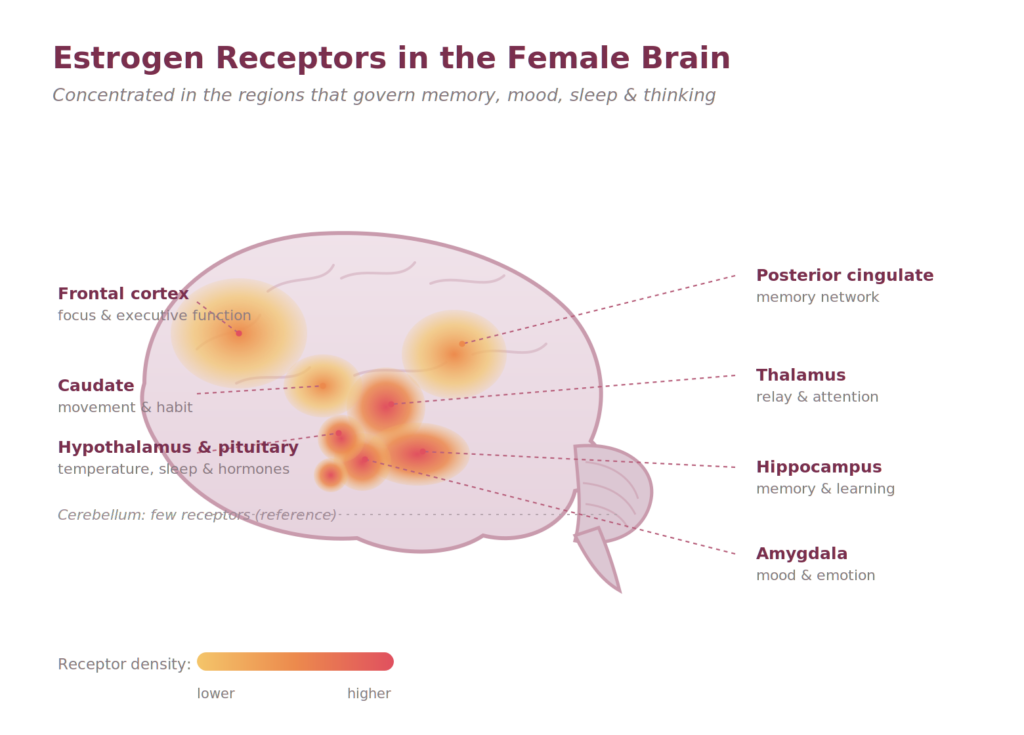
Here’s the piece that reframes everything: estrogen isn’t just a reproductive hormone — it’s a master regulator of brain function. Estrogen receptors are distributed throughout the female brain, concentrated in exactly the regions that govern memory, attention, mood, and processing: the hippocampus (memory), the prefrontal cortex (executive function), and more. Estrogen supports how brain cells use energy, communicate, and regulate key messengers like dopamine, serotonin, and acetylcholine.
So when estrogen becomes erratic and then declines through the menopause transition, the brain regions that depend on it feel the turbulence. This isn’t vague — it’s the neurological signature of exactly the symptoms women describe.
The Mosconi research — seeing it on a brain scan
Some of the most illuminating work here comes from Dr. Lisa Mosconi and her team at Weill Cornell’s Women’s Brain Initiative. Using advanced PET brain imaging, they were able, for the first time, to actually measure estrogen receptor activity in living women’s brains across the menopause transition. Two findings stand out:
- As women moved from pre- to peri- to post-menopause, the brain showed a progressively higher density of estrogen receptors in estrogen-regulated networks — as if the brain, sensing less estrogen to bind, was putting out more “docking stations” trying to catch what little remained. A brain compensating under strain.
- Crucially, higher receptor density in certain regions correlated with the cognitive and mood symptoms women actually reported. The brain changes lined up with the lived experience — objective proof that brain fog isn’t imagined.
Mosconi’s broader work also underscores something sobering and important: Alzheimer’s disease is far more common in women (about two-thirds of patients are women), and the biological groundwork appears to begin in midlife, not old age. She makes a key conceptual point — it’s not estrogen alone that matters, but the pairing of estrogen with its receptor, like a key in a lock. This is why midlife is being reframed as a critical window for protecting the female brain — not a cause for panic, but a call to pay attention now, when intervention has the most leverage.
Estrogen receptors in the female brain (click here)
The ADHD connection: is menopause “unmasking” something?
This is one of the most clinically interesting developments in women’s health, and it deserves real attention. Many women arrive in perimenopause feeling as though they’ve suddenly developed ADHD — and for a meaningful number, what’s actually happening is that menopause is unmasking an ADHD that was there all along, just never recognized.
Why do so many women reach midlife undiagnosed?
To understand this, you have to understand how differently ADHD has been recognized in girls versus boys:
- Boys more often show the hyperactive, disruptive presentation — the kid who can’t sit still and acts out. It gets noticed, referred, and diagnosed.
- Girls more often have the inattentive presentation — daydreamy, disorganized, quietly struggling but not disruptive. They were the “spacey” or “scattered” girls, not the ones sent to the principal. Researchers have long called them a “silent minority.”
- Girls also tend to internalize — anxiety, low self-esteem — and are frequently misdiagnosed with anxiety or depression instead of ADHD.
- And many bright, capable girls simply compensated — with intelligence, effort, rigid organization, and people-pleasing — masking their struggles for decades.
Why the mask slips at menopause
Here’s the mechanism. Estrogen boosts dopamine — the very neurotransmitter that’s dysregulated in ADHD and that governs focus, motivation, and executive function. For years, a woman’s estrogen helped prop up a dopamine system that was always running lean, and her coping strategies covered the rest. Then perimenopause arrives: estrogen swings and falls, dopamine support drops, and the scaffolding that held everything together gives way. Symptoms that were always simmering suddenly boil over — and the compensating strategies that worked for thirty years stop working. Studies even show that on days when estradiol is lower, ADHD symptoms measurably worsen.
Why this matters
If you’ve spent your life feeling like you were working twice as hard to stay organized, and midlife has blown that up — it may be worth exploring whether ADHD has been part of your story all along. A proper evaluation can be genuinely life-changing: it reframes decades of self-blame, and it opens up real treatment options. This is a conversation worth having with a knowledgeable clinician, because the overlap between menopausal brain fog and ADHD is significant, and telling them apart (or recognizing both) takes care.
What actually helps?
Now the practical part. The good news is that the strongest interventions for your brain are the same foundations that help everything else in midlife — and they’re genuinely effective.
The foundation (this is where the real gains are)
Evidence-backed lifestyle levers
- Sleep — protect it fiercely. This may be the single most powerful lever. Deep sleep is when the brain clears metabolic waste (via the glymphatic system) — including the proteins implicated in Alzheimer’s. Poor sleep alone can produce brain fog. Treating the night sweats and insomnia of menopause pays direct cognitive dividends.
- Exercise — especially strength and cardio together. Physical activity is one of the best-proven protectors of cognition and mood, improving blood flow, growth factors, and insulin sensitivity in the brain.
- Nutrition — whole-food, plant-forward, omega-3-rich. A Mediterranean-style pattern supports brain health; adequate protein and healthy fats matter.
- Avoid the substances that fog the brain. Alcohol is a major, underappreciated culprit — it worsens sleep, mood, and cognition, and midlife is a good time to cut back. Minimize other sedating or recreational substances too.
- Manage stress and stay mentally and socially engaged. Chronic stress and cortisol impair memory; connection and cognitive challenge protect it.
- Treat the medical contributors. Thyroid disease, anemia, B12 deficiency, uncontrolled blood pressure or blood sugar, and depression all cause “brain fog” and are worth checking.
Menopause hormone therapy (MHT) — helpful, with honest nuance
Here’s where I’ll be precise, because this is often oversold in both directions. MHT is not approved or recommended solely to treat cognitive symptoms, and the large randomized trials do not show that hormones reliably boost memory or “cure” brain fog on their own. That’s the honest headline.
However — and this matters — MHT often helps brain fog indirectly and substantially, by treating the things that are degrading your cognition: it relieves the hot flashes and night sweats wrecking your sleep, improves that sleep, and eases mood symptoms. Clinicians very commonly see meaningful cognitive improvement in women on MHT for these reasons, even though “brain fog” isn’t the formal indication. There’s also a “timing” theme in the research — hormones started earlier in the transition appear more favorable for the brain than those started many years after menopause. Whether MHT is right for you depends on your full picture, and it’s a conversation worth having.
Supplements — sorting the useful from the hype
The supplement industry has descended on menopausal brain fog with enthusiasm that outpaces the evidence. Here’s my honest sorting:
| Supplement | Verdict | The honest take |
|---|---|---|
| Omega-3 (EPA/DHA) | Reasonable | DHA is structurally central to brain cells, and higher omega-3 levels track with better brain aging. Best if your intake is low. Food-first (fatty fish); supplement is low-risk. |
| Vitamin B12 (& folate) | Yes, if low | True deficiency genuinely causes cognitive symptoms and is common in midlife (and with acid-reducers/metformin). Worth testing and correcting — not megadosing if you’re replete. |
| Vitamin D | Yes, if low | Correct a deficiency (see the vitamin D post); no proven cognitive benefit beyond sufficiency. |
| Magnesium | Supportive | Mainly helps indirectly via sleep and calm (see the magnesium post). Glycinate or L-threonate if you try it. |
| Creatine | Emerging | Early, interesting signals for cognition and mood alongside its muscle benefits. Promising, not proven for brain fog. |
| Ginkgo biloba | Mostly hype | Popular, but the evidence for preventing cognitive decline or fixing brain fog is weak. Also increases bleeding risk with blood thinners. |
| Bacopa, “nootropic” blends, most menopause “brain” formulas | Unproven | Heavily marketed, thin evidence in this specific population. Proprietary blends often hide small, ineffective doses. Save your money. |
The pattern is consistent: supplements help mainly by correcting a genuine deficiency (B12, D, omega-3s if you’re low), not by supercharging a healthy brain. The exciting-sounding nootropics are mostly marketing. Put your energy and money into sleep, movement, and treating the real contributors first.
The bottom line
- Brain fog is real, not a character flaw — word-finding, executive-function, and memory struggles driven by estrogen’s decline. For most women it improves; significant or progressive loss still deserves evaluation.
- Your brain runs on estrogen — receptors fill the memory and executive regions, and Mosconi’s imaging shows the brain visibly compensating, with changes that match women’s reported symptoms.
- Menopause can unmask ADHD — especially in women whose inattentive, internalized presentation went unrecognized in girlhood; falling estrogen removes the dopamine support that masked it. Worth exploring.
- The best medicine is the foundation: sleep above all, exercise, nutrition, avoiding alcohol, managing stress, and treating thyroid/B12/mood contributors.
- MHT isn’t for cognition alone, but often helps substantially by fixing sleep and vasomotor symptoms — an individual decision.
- Supplements: correct real deficiencies (B12, D, omega-3s); most “brain” nootropics are hype.
You are not losing your mind. You’re moving through a profound neurological transition — and there’s a great deal you and your physician can do to help you think clearly again.
If brain fog is frightening you, or you’re wondering whether ADHD has been part of your story, please know this is exactly the kind of thing worth sorting through carefully together — for real answers and a real plan.
Selected References
- Mosconi L, et al. In vivo brain estrogen receptor density by neuroendocrine aging and relationships with cognition and symptomatology. Sci Rep. 2024;14:12680.
- Mosconi L, et al. Women’s midlife: the front line of Alzheimer prevention. J Clin Invest. 2026.
- Mosconi L. The Menopause Brain (2024); Weill Cornell Women’s Brain Initiative.
- Systematic review and meta-analysis of the effects of menopause hormone therapy on cognition (34 RCTs; no overall cognitive benefit; effects varied by timing/formulation). 2024. PMC10944893.
- Maki PM, et al. Brain fog in menopause: a health-care professional’s guide for decision-making and counseling on cognition. Climacteric. 2022;25(6):570–578.
- Eunethydis Special Interest Group on Female ADHD. Research advances and future directions in female ADHD: the lifelong interplay of hormonal fluctuations with mood, cognition, and disease. Front Glob Womens Health. 2025. PMC12277363.
- Skoglund C, et al. / narrative reviews on ADHD across (peri)menopause: unmasking, estrogen–dopamine interaction, and management. Drugs Aging. 2026.
- Gender differences in ADHD: inattentive presentation, internalizing symptoms, and underdiagnosis in girls (“silent minority”). BMC Psychiatry / BJPsych reviews.
- Henderson VW, et al. Cognitive effects of estradiol after menopause: a randomized trial of the timing hypothesis. Neurology. 2016;87(7):699–708.
This article is for educational purposes and reflects the state of the evidence at the time of writing; it is not a substitute for individualized medical advice. Brain fog has many causes — including thyroid disease, B12 deficiency, anemia, medication effects, depression, and sleep disorders — so new, significant, or progressive cognitive or memory changes should be evaluated by your own clinician rather than assumed to be menopause. Decisions about hormone therapy, ADHD evaluation or medication, and supplements should be made together with your physician in the context of your personal health history. Supplement quality is not uniformly regulated.