
Sexual Health, Part 3: Arousal & Orgasm — When the Body Won’t Cooperate
You want to. You’re interested, you’re engaged — and yet your body doesn’t follow. Arousal is slow or absent, or orgasm, which once came easily, now feels out of reach or has disappeared entirely. This is one of the most frustrating and least-discussed parts of midlife sexuality. It’s also, in most cases, treatable — and the most effective treatments may surprise you.
In this series we’ve covered GSM (the physical comfort) and libido (the desire). Now we turn to what happens when desire is there but the body’s response isn’t: the arousal and orgasm phases. Let’s demystify them.
Arousal vs. orgasm: two different things
It helps to separate these, because they’re distinct and can go wrong independently:
- Arousal is the body’s “turning on” — increased blood flow to the clitoris and vulva, swelling, lubrication, heightened sensitivity. When this is persistently difficult despite adequate stimulation and interest, it’s called female sexual arousal disorder.
- Orgasm is the peak and release. When arousal is normal but orgasm is markedly delayed, much less intense, or absent — and it distresses you — it’s called female orgasmic disorder.
They often travel together (poor arousal makes orgasm harder), and both become more common in midlife. The reassuring truth: difficulty here is usually not a sign that something is permanently broken.
Why arousal and orgasm change in midlife
Several threads, often braided together:
- Declining estrogen reduces blood flow and sensitivity in the genital tissues (the GSM we covered in Part 1), making arousal slower and physical response blunted.
- Declining testosterone can dampen both arousal and the intensity of orgasm.
- Slower physiology — like men, women simply take longer to become aroused with age; the body needs more time and more direct stimulation. This is normal, not a malfunction.
- Medications — antidepressants (SSRIs) are notorious for delaying or blocking orgasm; others contribute too.
- Mind and context — anxiety, distraction, “spectatoring” (watching and judging yourself during sex), stress, and relationship strain all powerfully interfere.
- Insufficient or wrong stimulation — one of the most common and most fixable causes, discussed below.
The single most important fact about female orgasm
Most women do not reach orgasm from penetration alone — the large majority need direct clitoral stimulation. This isn’t a dysfunction; it’s anatomy. If intercourse alone has stopped working (or never reliably worked), that’s not a sign something is wrong with you — it usually means the stimulation isn’t matching what your body needs. Understanding this one fact resolves a great deal of unnecessary worry and self-blame, and it points directly toward what actually helps.
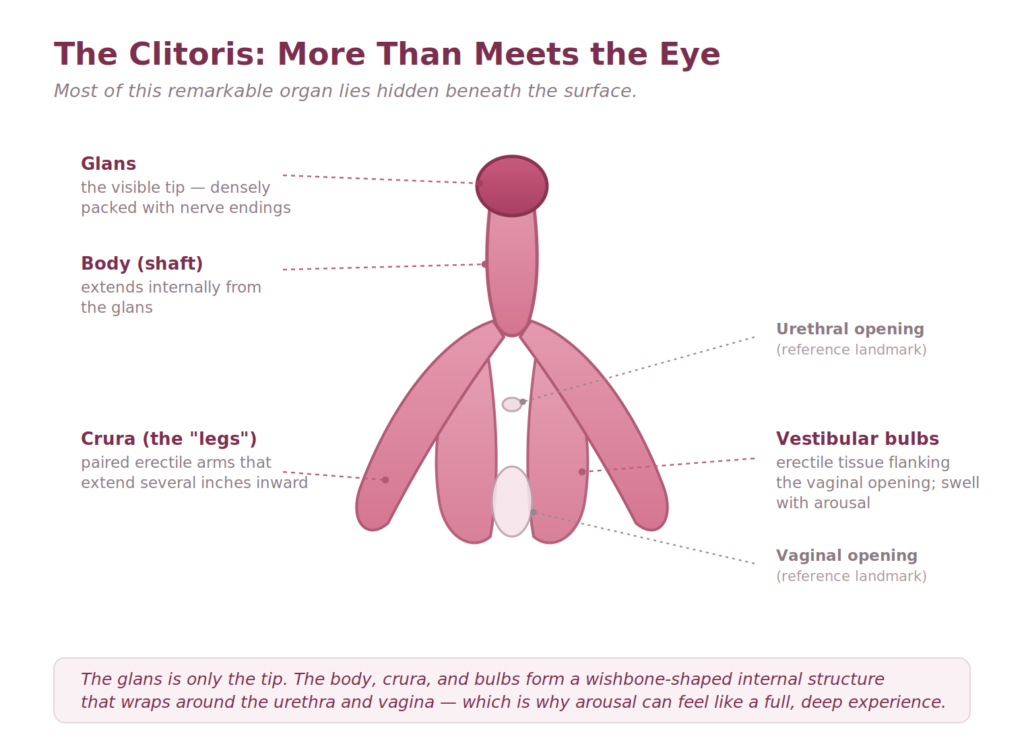
And here’s the anatomy that explains it, because it’s genuinely eye-opening: the clitoris is far larger than the small external tip (the glans) that most people picture. The visible glans is only the beginning — internally, the clitoris continues as a body (shaft) that splits into two paired “legs” (the crura) and two vestibular bulbs of erectile tissue that extend several inches inward and wrap around the urethra and vaginal canal. This whole wishbone-shaped structure engorges with arousal. So “clitoral” and “vaginal” pleasure aren’t really separate things — stimulation during penetration often works by indirectly engaging these internal parts of the clitoris. Knowing your own anatomy is quietly empowering, and it reframes what “working” stimulation actually means.
What actually works
Here’s the genuinely good news: the treatments for arousal and orgasm difficulties are effective, practical, and often don’t require medication at all.
The vibrator: the most effective, most underused tool
I say this plainly because women are often too embarrassed to hear it anywhere else: a vibrator is one of the most effective, evidence-based tools for arousal and orgasm difficulties — not a novelty, but a legitimate therapeutic device. The stronger, more consistent stimulation a vibrator provides can achieve what hands or intercourse alone cannot, especially when age has raised the threshold of stimulation your body needs. Placed on or near the clitoris, it reliably helps many women become aroused and reach orgasm, both alone and with a partner. There is no shame in using one; there is only relief in discovering it works.
Directed masturbation: the best-proven approach
This is the clinical term for a structured, step-by-step program of self-exploration and self-stimulation (often incorporating a vibrator), and it is the single best-evidenced treatment for orgasmic difficulty — especially for women who have never reliably reached orgasm. The results are genuinely impressive: studies show that a large majority of women — in some studies 50 to 100% — learn to reach orgasm this way, and many then transfer that ability to partnered sex. It works by letting you learn, without pressure or a partner’s presence, exactly what your body responds to — knowledge you can then bring into your relationship.
Sex therapy: more effective (and more normal) than you’d think
A certified sex therapist is a licensed professional who helps with exactly these issues — and the success rates are high. Their toolkit includes:
What sex therapy actually involves
- Sensate focus — structured touch exercises that rebuild pleasure and connection while removing performance pressure.
- Cognitive behavioral techniques — quieting the anxious, self-judging thoughts that block arousal and orgasm.
- Mindfulness — shown to meaningfully improve arousal and orgasm by helping women stay present in their bodies instead of in their heads.
- Education and communication skills — for you and, when relevant, your partner.
Seeing a sex therapist is not a sign of a failing relationship or a last resort — it’s a smart, effective step, and it’s completely confidential. I refer women to them often, and the feedback is overwhelmingly positive.
Addressing the physical and hormonal contributors
| Contributor | What can help |
|---|---|
| GSM / low estrogen | Local vaginal estrogen restores blood flow, sensitivity, and lubrication — often improving arousal directly (see Part 1). |
| Low testosterone | For postmenopausal women, carefully dosed testosterone can improve arousal and satisfaction (see Part 2’s caveats — off-label, monitored). |
| Medication side effects | If an SSRI is blocking orgasm, options include dose adjustment, switching agents, or adding bupropion — a conversation worth having with your prescriber. |
| Dryness / friction | Good lubricants and moisturizers make stimulation more comfortable and effective (see Part 1). |
A gentle, practical reframe
So much of arousal and orgasm in midlife comes down to more time, more (and the right kind of) stimulation, less pressure, and less self-judgment. Slowing down, adding a vibrator, prioritizing clitoral stimulation, treating the tissue, and getting out of your own head aren’t consolation prizes — for most women, they are the solution. Your capacity for pleasure doesn’t vanish in midlife; it just asks you to meet it a little differently.
The bottom line
- Arousal and orgasm are distinct — arousal is the body “turning on,” orgasm is the peak; either can falter, and both become more common to struggle with in midlife.
- Most women need direct clitoral stimulation to orgasm — penetration alone usually isn’t enough, and that’s anatomy, not dysfunction.
- The vibrator is a legitimate, highly effective tool — not a novelty — providing the stronger, consistent stimulation midlife bodies often need.
- Directed masturbation is the best-proven treatment for orgasmic difficulty, with a majority of women learning to reach orgasm and transfer it to partnered sex.
- Sex therapy works — sensate focus, CBT, and mindfulness have strong success rates and are nothing to be embarrassed about.
- Treat the physical contributors — local estrogen for GSM, testosterone where appropriate, reviewing orgasm-blocking medications, and good lubrication.
Pleasure is not something you age out of. With the right understanding and tools, arousal and orgasm are, for most women, very much within reach again. If arousal or orgasm has become difficult and it’s weighing on you, please know these are real, common, and treatable concerns — not things you simply have to accept. Sorting out what will work for your body is exactly the kind of conversation I welcome.
Coming next — the series finale
In our final installment, we’ll tackle the special situations: pelvic floor disorders, sex after hysterectomy, sex after cancer, and outercourse as a satisfying option. Stay tuned.
Selected References
- Meston CM, et al. Disorders of orgasm in women: directed masturbation as first-line, evidence-based treatment (50–100% success in lifelong anorgasmia). J Sex Med / Meston Lab, UT Austin.
- Female Orgasmic Disorder — treatment overview (directed masturbation first-line; vibrator near the clitoris; sex therapy; pelvic floor PT). Merck/MSD Manual, Professional Edition. 2025.
- Laan E, et al. Cognitive-behavioral and mindfulness-based therapy for female arousal and orgasmic disorder (success rates ~88–90%). Reviews in sexual medicine.
- Brotto LA. Mindfulness-based interventions for female sexual arousal, desire, and orgasm difficulties. Arch Sex Behav / J Sex Med.
- Faubion SS, et al. Sexual dysfunction in women: a practical approach (directed masturbation for anorgasmia; local estrogen; transdermal testosterone for desire/arousal). Am Fam Physician. 2015.
- Herbenick D, et al. Prevalence and characteristics of vibrator use by women in the United States. J Sex Med. 2009.
- Longhurst GJ, et al. Beyond the tip of the iceberg: a meta-analysis of the anatomy of the clitoris (glans, body, paired crura, and vestibular bulbs; internal portion comprises most of its mass). Clin Anat. 2024;37(2):177–190.
- O’Connell HE, et al. Anatomy of the clitoris. J Urol. 2005;174(4):1189–1195.
This article is for educational purposes and reflects the state of the evidence at the time of writing; it is not a substitute for individualized medical advice. Persistent difficulty with arousal or orgasm can have medical, hormonal, medication-related, and psychological contributors worth evaluating. Decisions about hormone therapy, testosterone, or medication changes should be made with your own clinician, and a referral to a certified sex therapist or pelvic floor physical therapist may be appropriate.